Choosing the right insulation begins with a practical question: what insulation options are available for metal buildings? The answer depends on climate, building use, budget, condensation risk, and installation quality. A warehouse in Harbin needs a different strategy from a workshop in Guangzhou. The roof also faces stronger solar heat than an interior wall.
Common choices include fiberglass blanket, rigid foam boards, mineral wool, spray polyurethane foam, and reflective foil systems. Fiberglass blanket is widely used in Chinese steel buildings because it is affordable and quick to install. Rigid boards provide continuous thermal resistance, but their joints need careful sealing. Mineral wool offers strong fire performance and sound control. Spray foam can seal irregular gaps around purlins and penetrations. It costs more, and poor application can create hidden defects.
Building scientist Joseph Lstiburek has stated, “A building enclosure is a system, not a collection of parts.” That principle matters here. Insulation alone cannot solve air leakage, thermal bridging, or roof condensation. A thin vapor barrier with an open seam may fail during a humid summer. A thick layer can still underperform when compression leaves cold stripes between steel members.
This guide compares leading insulation options for metal buildings made or supplied in China. It considers R-value, moisture control, fire resistance, durability, installation conditions, and long-term maintenance. Product certificates matter. So do factory experience and installer training. There is no universal winner. Some recommendations may need revision after a site inspection, especially when local weather data or actual assembly details are missing.
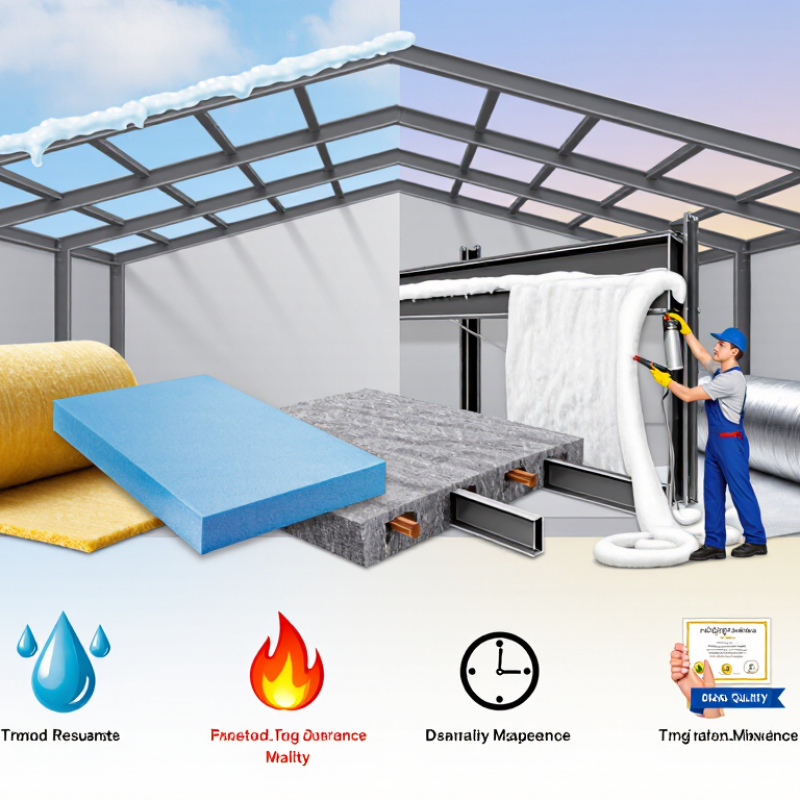
Chinese metal buildings commonly use glass wool blankets, rock wool panels, EPS, and PIR or PUR sandwich panels. Glass wool is lightweight and flexible, fitting roof profiles and reducing installation time. Rock wool offers stronger fire resistance and better acoustic control, which suits factories with machinery noise. EPS usually costs less, but it needs careful fire and moisture assessment. PIR provides strong thermal resistance within a thinner panel, yet joints and damaged surfaces can reduce its real performance.
The IEA’s Buildings 2023 report states that buildings consume about 30% of global final energy and produce around 26% of energy-related emissions. This makes insulation selection more than a cost decision. In China’s hot summers and cold northern winters, designers should check thermal conductivity, panel thickness, vapor control, and thermal bridges around purlins. A small steel connection can become a cold spot.
Condensation often appears beneath roof sheets when indoor humidity rises. Continuous insulation, sealed laps, and correctly placed vapor barriers help control this risk. Factory experience also shows that installation quality can outweigh laboratory values. A perfect material may perform poorly after compression or open joints.
No option wins every project. Local climate, fire requirements, span details, and maintenance plans must guide the specification. IEA’s 2023 Global Status Report for Buildings and Construction also supports reducing operational energy through better envelopes, although insulation alone cannot solve every building problem.
China Top Metal Building Insulation Options?
Selecting insulation for a metal building requires more than comparing advertised R-values. Moisture control, thermal bridging, fire performance, and installation quality all affect real results. The International Energy Agency’s Buildings 2023 report states that buildings consume about 30% of global final energy. Metal envelopes deserve careful attention.
Mineral wool, fiberglass blankets, rigid foam, and spray-applied systems offer different performance profiles. Fiberglass blankets are practical for large roofs, but compression can reduce their effective R-value. Rigid foam provides continuous coverage and limits thermal bridges at purlins. Mineral wool adds strong fire resistance and sound absorption. Spray systems can seal irregular joints, although workmanship becomes critical.
Look closely at condensation risk. Warm indoor air can reach cold roof panels through gaps, creating hidden moisture and corrosion. ASHRAE Handbook guidance emphasizes controlling air movement and vapor diffusion, not insulation thickness alone. Thermal spacers, sealed penetrations, and properly lapped vapor retarders often matter more than expected.
Air leakage is costly.
The U.S. Department of Energy identifies insulation and air sealing as key measures for reducing building heating and cooling loads. Still, published laboratory values may not match field performance. I have seen small unsealed edges undermine an otherwise impressive assembly. Climate zone, indoor humidity, roof color, equipment loads, and future maintenance should guide the final specification. Performance testing is worth considering before full installation.
Metal buildings in China face varied insulation demands, from humid coastal air to cold northern winters. The best option balances thermal, acoustic, fire, and moisture resistance.
Mineral wool provides strong fire performance and reduces noise from rain, machinery, and nearby traffic. It also tolerates high temperatures better than many foam products. Fiberglass is lightweight and economical, but it needs careful installation around joints and fasteners. Gaps can create cold spots. Rigid foam offers high thermal resistance in thin panels, yet its fire behavior depends on the complete wall or roof assembly. It may also require protected surfaces. Moisture control remains critical. A vapor retarder, sealed overlaps, and proper drainage help prevent condensation beneath metal sheets.
Tips: Inspect the roof underside during a cool morning. Look for damp marks, rust, compressed insulation, and loose seams. Specify tested assemblies, not isolated material claims. Ask for thermal, acoustic, and fire test data suited to the intended building. Local installers may understand climate exposure better than a generic design guide. Still, site quality varies, so independent inspection is worthwhile. Even excellent insulation can underperform when penetrations remain unsealed.
China’s Top Metal Building Insulation Options
China’s metal buildings need insulation that controls heat, noise, fire risk, and condensation. Mineral wool is a strong choice for factories, warehouses, and fire-rated wall systems. Its dense fibers resist heat and reduce machinery noise. Installation matters. Compressed joints or gaps can weaken the whole envelope.
Glass wool suits roofs, partition walls, and large interior areas where low weight and easy handling matter. It fits around purlins and services, but careless cutting can leave thin spots. Polyisocyanurate and polyurethane boards provide high thermal resistance in cold rooms, insulated panels, and energy-conscious workshops. Their closed cells help limit moisture movement. However, joints need accurate sealing.
Expanded polystyrene is often selected for economical wall and roof panels, especially in moderate climates. It is light and practical, yet fire performance and local code requirements must be checked carefully. On site, installers should review climate data, panel orientation, fasteners, and vapor-control details before ordering materials. A reliable specification confirms density, thickness, fire classification, and tested thermal values. No material wins every project. Budget pressure can distort decisions. Independent test data should guide the final selection.
| Insulation Material | Typical Thermal Conductivity (W/m·K) |
Common Forms for Metal Buildings | Typical Applications | Key Advantages | Important Considerations | Relative Cost Level |
|---|---|---|---|---|---|---|
| Mineral Wool | 0.034–0.045 | Blankets, boards, roof panels, cavity batts | Factories, warehouses, workshops, roofs, walls, fire-rated assemblies | Non-combustible mineral fiber, strong fire performance, good acoustic absorption, dimensionally stable | Can absorb water if left unprotected; requires careful handling and a continuous vapor-control strategy where needed | Medium |
| Glass Wool | 0.032–0.044 | Flexible rolls, blankets, acoustic panels, sandwich-panel cores | Metal roofs, industrial walls, suspended ceilings, light commercial buildings | Lightweight, economical, easy to install between purlins or framing, effective for sound absorption | Must be protected from compression and moisture; exposed fibers require suitable facing and installation controls | Low to Medium |
| Expanded Polystyrene (EPS) | 0.035–0.040 | Rigid boards, insulated panels, roof and wall inserts | Budget-conscious warehouse walls, roofs, partitions, and low-rise commercial structures | Low density, easy to cut, widely available, relatively low material cost | Combustible; needs an approved protective assembly, adequate fire detailing, and protection from solvents and prolonged moisture | Low |
| Extruded Polystyrene (XPS) | 0.029–0.036 | Rigid closed-cell boards, protected roof insulation, base and perimeter boards | Moisture-exposed roofs, floor slabs, foundations, cold-storage perimeter areas | Low water absorption, good compressive strength, consistent rigid-board performance | Combustible; thermal performance can decline with aging, and compatibility with adhesives and membranes must be checked | Medium |
| Polyisocyanurate (PIR) | 0.022–0.028 | Rigid boards, insulated metal sandwich panels, roof panels | Energy-efficient factories, logistics centers, commercial roofs, temperature-controlled buildings | High insulation value per unit thickness, lightweight, suitable for space-limited roof and wall systems | Combustible polymer core; fire behavior depends on formulation, facings, joints, thickness, and the tested assembly | Medium to High |
| Polyurethane (PUR) | 0.022–0.028 | Rigid sandwich-panel cores, spray-applied foam, insulated roof and wall boards | Cold rooms, refrigerated buildings, industrial roofs, wall systems requiring high thermal resistance | Very good insulation per thickness, closed-cell moisture resistance, can reduce air leakage when properly installed | Combustible; installation quality affects adhesion, continuity, dimensional stability, and long-term performance | Medium to High |
| Phenolic Foam | 0.020–0.025 | Rigid boards, insulated panels, duct and service-area insulation | High-performance wall systems, roofs, compact plant rooms, buildings with limited insulation depth | Very low thermal conductivity, thin build-up for a target insulation level, generally lower smoke production than many thermoplastics | Can be brittle; edge detailing and moisture protection are important, and fire ratings must be verified for the complete system | High |
| Cellular Glass | 0.038–0.055 | Rigid boards and blocks, roof and foundation insulation systems | Industrial facilities, below-grade areas, high-humidity zones, areas requiring vapor resistance | Non-combustible, closed-cell, highly resistant to water and vapor, durable and dimensionally stable | Heavy and relatively expensive; brittle edges require careful cutting, jointing, and mechanical protection | High |
| Aerogel Blanket | 0.013–0.020 | Flexible blankets, removable covers, thermal-bridge and retrofit layers | Space-constrained retrofits, complex steel details, pipework, equipment, and localized thermal bridges | Exceptional insulation per thickness, flexible, useful where conventional boards cannot fit | High purchase cost; requires protective facing, correct compression control, and detailed installation | Very High |
Note: Thermal-conductivity values are typical product ranges measured under specified laboratory conditions. Actual performance depends on thickness, density, temperature, moisture, joints, fasteners, thermal bridges, ventilation, and the complete tested roof or wall assembly. Fire classification and code compliance should be confirmed against the applicable Chinese standards and project requirements.
Choosing insulation for a metal building requires more than comparing thermal ratings. Mineral wool offers strong fire resistance and sound control. PIR panels provide high thermal performance with less thickness. Reflective foil can help under specific roof conditions, but it cannot replace properly fitted insulation. In China, confirm the design against local building, fire, energy, and occupational safety requirements. Check product certificates, tested fire performance, and declared thermal conductivity. Details matter.
Installation quality often controls the final result. Workers should seal panel joints, protect insulation from moisture, and avoid compressed or missing sections around screws and openings. A continuous vapor-control layer may be necessary in humid interiors. Metal bridges can create cold lines, condensation, and rust. Costs commonly include materials, labor, access equipment, trimming, and waste. As a rough planning range, insulation systems may cost about RMB 90–280 per square meter, depending on thickness, fire rating, structure, and site conditions. Actual quotations can differ sharply.
Tips: Request a sample installation before approving the full area. Use a thermal camera after installation, especially near corners and roof penetrations. Keep maintenance records. Inspect damaged facing, loose fasteners, leaks, and wet insulation at least twice yearly. Replace soaked material rather than simply drying its surface. That shortcut sometimes fails. I would also leave spare panels and matching sealants onsite; future repairs rarely happen under ideal conditions. Recheck insulation performance after major roof work or machinery upgrades.
Indicative installed cost, thermal performance, and service-life comparison for common metal-building insulation systems.
Cost figures are indicative 2025 market ranges in China for material and installation, shown as midpoints in CNY/m² and excluding structural upgrades, taxes, difficult access, and regional labor differences. R-values are typical nominal values per inch. Verify the final design against GB 50176, GB 55015, applicable local energy-efficiency requirements, and the relevant fire-classification provisions of GB 8624. Long-term maintenance mainly involves checking exposed surfaces, moisture ingress, damaged vapor barriers, sealants, and panel penetrations.
Common options include glass wool, rock wool, expanded polystyrene, and rigid foam panels. No material wins every project. Local climate and building use should guide the choice.
Glass wool suits roofs, partition walls, and large interior areas. Its light weight makes handling easier around purlins and service lines. Careless cutting can create thin spots.
Rock wool provides strong fire resistance and helps reduce machinery noise. Its dense fibers suit factories, warehouses, and fire-rated wall systems. Compressed joints can weaken performance.
It can suit economical wall and roof panels in moderate climates. However, fire behavior and moisture exposure require careful checking. Cheap is not always better.
Polyisocyanurate and polyurethane panels offer high thermal resistance in thin sections. Their closed cells help limit moisture movement. Joints need accurate sealing.
Northern buildings may need stronger winter protection and vapor control. Hot regions need careful attention to summer heat and roof temperatures. Climate data matters.
Continuous insulation, sealed laps, and correctly placed vapor barriers help limit condensation. Indoor humidity can cause moisture beneath roof sheets. Small gaps matter.
Yes. Compression, open joints, damaged surfaces, and thermal bridges can reduce real performance. Steel connections near purlins may become cold spots. Installation decides.
Review thickness, density, fire classification, thermal values, fasteners, and panel orientation. Confirm tested data and site conditions before purchase. The decision can still be wrong.
Choosing the right insulation for a metal building in China requires balancing thermal performance, acoustic control, fire safety, moisture resistance, cost, and long-term durability. This article explains what insulation options are available for metal buildings, including mineral wool, fiberglass, rigid foam boards, spray-applied foam, and reflective insulation systems. Each material has different strengths: some provide strong heat retention, others reduce noise, improve fire resistance, or help control condensation in humid environments.
The discussion also compares typical applications, such as roofs, walls, workshops, warehouses, and temperature-controlled facilities. It highlights the importance of selecting materials that match local climate conditions, building use, and applicable installation standards. Proper detailing around joints, fasteners, openings, and vapor barriers is essential for reliable performance. Although initial costs vary according to material, thickness, labor, and project complexity, high-quality installation can reduce energy consumption and maintenance needs over time. Regular inspections for moisture, compression, damage, and gaps can further extend the insulation system’s service life.

Dhingia Build