Choosing among the 2026 best steel manufacturers requires more than comparing prices, production capacity, or polished factory photographs. Reliable certification shows how a manufacturer controls materials, processes, workers, and records. Yet certificates need careful reading. Their value depends on scope, issuing body, validity dates, and actual factory practices.
A useful buyer question is: “what certifications should steel building manufacturers have?” ISO 9001 can indicate a structured quality management system. ISO 14001 addresses environmental management, while ISO 45001 focuses on occupational health and safety. For structural steelwork, EN 1090, AWS D1.1, or AISC-related credentials may matter, depending on the project location and design standard. Product compliance may also require ASTM, CSA, CE, or other recognized specifications.
Look beyond logos.
Request sample mill test certificates with heat numbers, inspection reports, welding procedure qualifications, and traceability records. Ask whether independent inspectors verify dimensions, coating thickness, weld quality, and loading performance. A serious manufacturer should explain which standards apply to your building, not simply list every certificate available. Certification is helpful, but it is not conclusive proof of excellent workmanship. An audit may capture one period, while production quality can change later. That limitation deserves attention.
Buyers should also confirm accreditation through the certification body’s public database whenever possible. Local building codes, fire requirements, seismic conditions, and import rules can alter the necessary documentation. The strongest supplier combines valid certifications with transparent communication, consistent testing, experienced engineers, and evidence from comparable projects. This approach reduces avoidable risk and supports a more defensible purchasing decision.
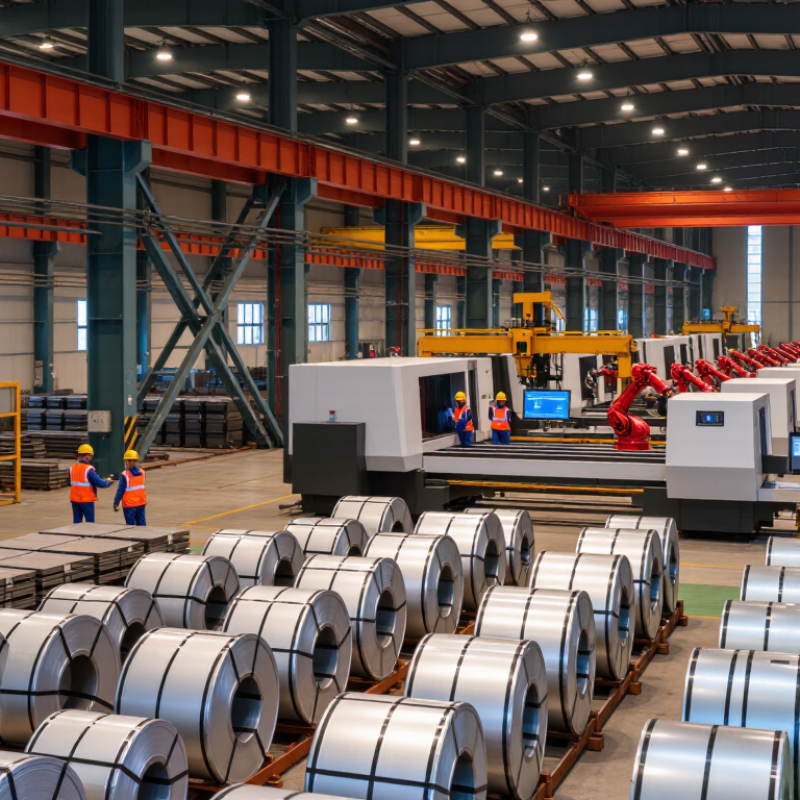
Global steel output reached about 1.89 billion tonnes in 2023, according to the World Steel Association’s World Steel in Figures 2024. That scale makes certification more than a purchasing formality. Every coil, plate, and beam can carry risks involving quality variation, emissions, worker safety, and traceability. The International Energy Agency reports that iron and steel production creates roughly 7% of global energy-related emissions. Buyers therefore need evidence, not broad sustainability claims.
ISO 9001 can show whether a mill controls processes, records, and corrective actions. ISO 14001 addresses environmental management, while ISO 45001 focuses on occupational health and safety. These systems matter during supplier audits. They reveal how a plant handles furnace dust, inspection failures, training records, and emergency procedures. Product compliance also needs attention. Relevant ASTM, EN, or national standards should match the final use, thickness, grade, and testing method.
Certification is not proof of perfect steel. That is an uncomfortable point. A valid certificate may cover only one facility or product range. It may also expire between orders. Experienced buyers should check the issuing body, audit date, certificate scope, mill test reports, and chain-of-custody records. Environmental Product Declarations can add lifecycle data, but their figures depend on boundaries and verified inputs. I have seen procurement teams focus on logos and miss the small print. That mistake remains expensive.
In 2026, steel buyers should examine quality systems, not only tensile strength or delivery capacity. The World Steel Association reported 1.892 billion tonnes of crude steel production in 2023. At that scale, small process errors can become expensive supply problems.
ISO 9001 shows whether a steelmaker controls documented processes, customer requirements, corrective actions, and internal audits. The ISO Survey of Certifications 2022 recorded 1,265,216 ISO 9001 certificates worldwide. That figure signals broad adoption, but certification alone proves little about daily discipline. Buyers should review audit findings, traceability samples, calibration records, and recent nonconformity closures. The paperwork may look perfect.
IATF 16949 adds stronger expectations for automotive supply chains. It emphasizes risk-based thinking, product safety, defect prevention, change control, and supplier performance. A steel producer supplying automotive components should explain how heat numbers follow material from furnace to shipment. Certificates should also cover the relevant production site and scope, not merely a corporate office. Industry audits often reveal an uncomfortable gap between written procedures and shop-floor behavior. A practical assessment should include interviews with operators, witnessed testing, and evidence from returned or rejected material. These checks require time, and buyers sometimes skip them under schedule pressure. That choice deserves reconsideration.
| Evaluation Dimension | ISO 9001:2015 | IATF 16949:2016 | Evidence to Request from a Steelmaker | Buyer Relevance |
|---|---|---|---|---|
| Primary purpose | General quality management system standard applicable to organizations of any size and industry. | Automotive quality management standard built on ISO 9001 requirements, with additional customer-specific and automotive-sector controls. | Valid certificate, certification scope, covered production sites, and stated products or processes. | Shows whether the management system matches the intended steel application and supply chain. |
| Process approach | Requires identification, control, monitoring, and improvement of interconnected processes. | Adds stronger controls for manufacturing processes, product safety, risk management, and prevention of variation and waste. | Process maps covering steelmaking, casting, rolling, heat treatment, finishing, inspection, packing, and dispatch. | Helps assess consistency from raw-material receipt through final shipment. |
| Customer requirements | Requires the organization to determine and meet applicable customer and legal requirements. | Requires systematic handling of customer-specific requirements and automotive customer expectations. | Contract-review records, specification review, change approvals, and customer complaint trends. | Reduces the risk of supplying material that does not meet grade, dimensional, surface, or documentation requirements. |
| Risk management | Requires risk-based thinking in planning and operation of the quality management system. | Uses more detailed automotive risk and contingency-planning expectations, including controls for special characteristics and process failure. | Process FMEAs, control plans, contingency plans, risk registers, and evidence that actions are updated after failures or changes. | Indicates how the producer manages failures that could affect safety, performance, delivery, or traceability. |
| Product and process control | Requires controlled production, suitable monitoring, documented information, and release of conforming products. | Adds more prescriptive controls for process capability, error-proofing, product safety, and standardized work where applicable. | Inspection and test plans, calibration records, process capability studies, nonconformance records, and product-release data. | Provides measurable evidence that chemical, mechanical, dimensional, and surface requirements are controlled. |
| Traceability | Requires identification and traceability when necessary to ensure conformity. | Places stronger emphasis on traceability where required by regulation, customer requirements, or product-safety obligations. | Heat, cast, coil, plate, or batch identification; material certificates; digital or paper genealogy; recall or containment procedure. | Supports rapid containment and verification when a quality issue is discovered. |
| Measurement and laboratory control | Requires monitoring and measuring resources to be suitable, maintained, and calibrated or verified where applicable. | Adds automotive expectations for measurement-system analysis and control of inspection, measuring, and test equipment. | Calibration certificates, measurement-system studies, laboratory competence records, test-method references, and out-of-tolerance actions. | Improves confidence in tensile, hardness, chemistry, dimensional, coating, and other test results. |
| Supplier control | Requires evaluation, selection, monitoring, and re-evaluation of external providers according to their ability to meet requirements. | Requires more detailed supplier-development, performance-monitoring, and flow-down controls for automotive supply chains. | Approved-supplier list, incoming inspection, supplier scorecards, corrective actions, and certificates for critical inputs such as alloys or refractories. | Shows whether upstream variation is actively controlled rather than passed to the customer. |
| Corrective action | Requires response to nonconformity, root-cause analysis, corrective action, and review of effectiveness. | Expects more rigorous problem-solving, including disciplined analysis and prevention of recurrence across similar processes. | 8D or equivalent reports, root-cause evidence, containment timing, effectiveness checks, and repeat-defect rate. | Separates a manufacturer that only fixes defects from one that prevents recurring defects. |
| Internal audits and management review | Requires planned internal audits and management reviews to assess suitability, adequacy, effectiveness, and improvement opportunities. | Includes enhanced audit expectations for manufacturing processes, products, and the quality management system. | Audit schedules, findings, closure records, management-review outputs, quality objectives, and trend analysis. | Demonstrates that quality performance is reviewed systematically rather than only after customer complaints. |
| Certification audit cycle | Certification is commonly maintained through a three-year cycle with surveillance audits during the cycle, subject to the certification body’s program. | Typically follows a three-year certification cycle with surveillance audits conducted during the cycle under IATF rules. | Certificate status, issue and expiry dates, latest audit result, open major or minor findings, and certification-body details. | Confirms that certification is current and not merely an expired or unsupported marketing claim. |
| Best-fit application | Appropriate baseline for general industrial, construction, energy, engineering, and commercial steel applications. | Most relevant when supplying automotive original-equipment or automotive-tier production chains that require IATF compliance. | Customer segment, end-use risk, required specifications, product-safety obligations, and contractual certification requirements. | The more demanding standard is not automatically better; suitability depends on the buyer’s industry and risk profile. |
When comparing steel manufacturers in 2026, environmental credentials need careful reading. ISO 14001 shows that a company operates a structured environmental management system. It covers objectives, controls, monitoring, corrective action, and continual improvement. However, certification does not automatically prove low emissions or responsible raw materials. The certificate’s scope matters. A site may hold certification while other facilities remain outside its coverage.
ResponsibleSteel examines a broader set of issues. Its requirements can include greenhouse gas emissions, energy use, biodiversity, water, worker rights, community impacts, and responsible sourcing. Independent assessment adds useful credibility, especially when evidence comes from production sites rather than marketing departments. Look for the certified location, assessment date, included activities, and any disclosed findings.
Details matter.
In practice, I would compare both credentials with operational data. Ask for emissions intensity, renewable electricity use, recycled content, waste records, and improvement targets. Check whether figures are measured, verified, and reported consistently. A manufacturer with ISO 14001 may have disciplined processes but limited public results. A ResponsibleSteel-certified site may show wider social and environmental controls, yet certification still depends on scope and audit conditions. Neither label is a magic shield. Supplier records can change, and certificates can expire. A careful buyer should review current documents, request clarification, and avoid treating one logo as complete proof of responsible steel.
In steel manufacturing, ISO 45001 is more than a framed certificate. It tests whether safety controls work beside furnaces, rolling lines, cranes, and maintenance pits. A credible assessment examines hazard identification, risk controls, emergency planning, and worker consultation. It also checks documented procedures against actual behavior on the shop floor. That difference matters. A polished manual cannot protect a worker from an unguarded pinch point.
When evaluating a manufacturer, request evidence from recent internal audits, corrective actions, training records, and incident investigations. Look for trends in lost-time injuries, near misses, hand injuries, heat exposure, and contractor incidents. Numbers need context. A low report count may reflect strong prevention, or weak reporting culture. Interview operators privately, if possible. Their comments can reveal whether supervisors stop unsafe work, replace damaged equipment, and respect fatigue concerns. ISO 45001 expects participation, not silent attendance at a meeting.
Certification status should be verified through an accredited certification body, with scope and expiry dates clearly stated. The scope should cover the sites and processes involved in your supply decision. Ask how management handles recurring findings. Real improvement is visible in changed guarding, clearer permits, better ventilation, and faster corrective action. Even strong systems have gaps. Seasonal workers may receive less coaching, and production pressure can quietly erode controls. Those weaknesses deserve direct questions, not polite assumptions. A reliable manufacturer can explain failures without hiding them and show what changed afterward.
In 2026, steel buying decisions depend on more than a polished certificate. ASTM, EN, and JIS standards define different testing routes, grades, dimensions, and acceptance limits. A product meeting one standard is not automatically compliant with another. That distinction matters. During material reviews, I check the exact standard edition, grade designation, delivery condition, and test method. Small wording changes can alter performance requirements. Procurement teams should request these details before comparing prices.
A reliable mill test certificate should match the purchase order and identify the heat number. Traceability should continue from the certificate to the bundle tag, marking, and test sample. For mechanical properties, verify yield strength, tensile strength, elongation, impact results, and test temperature where required. Chemical analysis also deserves attention, especially carbon equivalents and elements affecting weldability. Independent inspection can add confidence when projects face severe fatigue, pressure, or temperature demands. Use laboratories with suitable competence and documented calibration. Paper is not proof alone.
EN documentation may reference harmonized testing practices, while ASTM and JIS records can use different terminology or sampling conventions. Ask the supplier to state every applicable standard, not simply write “international standard.” Confirm whether the document is a declaration, test report, or third-party inspection record. These documents do not carry equal evidential weight. I have seen excellent-looking reports fail because the heat number was incomplete or the standard edition was outdated. That is an uncomfortable gap. Digital records help, but data entry errors still occur. A second-person review is sensible. Keep signed records with inspection photographs and receiving logs.
Certification provides evidence about quality, environmental controls, safety, and traceability. Steel production is enormous. Buyers should not rely on broad sustainability claims alone.
No. A certificate may cover only one facility or product range. It may also expire before delivery. Small print matters.
Check the issuing organization, audit date, certificate scope, covered facility, and listed products. Confirm that the certificate remains valid during purchasing and delivery.
A capable mill should control production quality, environmental impacts, and worker safety. Review records for dust handling, failed inspections, staff training, and emergency procedures.
Match the product standard, grade, thickness, delivery condition, and test method with the purchase order. Different standards can use different limits and testing routes. Do not accept “international standard” without details.
It should match the purchase order and show the heat number. Verify yield strength, tensile strength, elongation, impact results, test temperature, and chemical analysis when required.
Traceability should connect the test certificate with the heat number, bundle tag, product marking, and test sample. Keep inspection photographs and receiving logs. Paper alone is weak evidence.
Independent inspection can help with demanding projects involving fatigue, pressure, or extreme temperatures. Use laboratories with suitable competence and documented calibration. It adds confidence, not certainty.
No. Environmental declarations provide lifecycle information, but results depend on boundaries, assumptions, and verified inputs. Buyers should examine the underlying data, not only the displayed figure.
Do not focus only on logos. Check outdated standard editions, incomplete heat numbers, and mismatched product details. Digital records help, but data entry errors still happen. A second review is sensible.
As global steel output surpasses 1.8 billion tonnes, certification has become a practical way to compare manufacturers in 2026. Quality credentials such as ISO 9001 and IATF 16949 indicate structured processes, traceability, consistency, and the ability to meet demanding automotive or engineering requirements. Environmental certifications, including ISO 14001 and ResponsibleSteel, help evaluate energy use, emissions management, resource efficiency, and responsible production practices.
Worker protection is another essential consideration. ISO 45001 demonstrates that a steelmaker has systems for identifying hazards, reducing workplace risks, and improving safety performance. Product compliance should also be verified through applicable ASTM, EN, or JIS standards, supported by reliable testing and documentation. For buyers asking what certifications should steel building manufacturers have, the answer depends on project requirements, but a strong combination of quality, environmental, safety, and product-standard certifications offers the clearest evidence of dependable manufacturing and responsible long-term performance.

Dhingia Build